

If you want to write, you have to read all the time because reading is the other half of writing. A person who is serious about identifying herself as a writer ought to say, “I’m a writer-reader.” We could get rid of that annoying hyphen and make it one word: writerreader. It’s hideous, but so are “stomachache” and “anodyne” and we get along with those all right.
Philip Roth said that the novel has about twenty-five years of relevancy left for the general public. Novels will still be written, he says, but the number of people who read them will get very small, similar in size to those groups of people who enjoy reading Latin poetry, say. Roth says that because print is changing so rapidly and because our pace of life is simply not matched to the form of a novel — neither in length or content — these particular sorts of books will fade away. Reading a novel takes focus, he says, focus and attention on one larger thing that we so often trade for many smaller things. “If you haven’t finished reading a novel in two weeks,” Roth said, “then you haven’t read the novel.”
While my hosts and I waited for a table at the restaurant in Georgia last weekend, I wandered into a used bookshop. I hunted for poetry but there was none to speak of, just a biography on Anne Sexton. (I think in my current brooding state five-hundred pages on the life of a brooding poet would be nothing short of disastrous.) The “Classic Literature” shelf drew my attention, but my perusal was desultory. As Roth said: a novel demands time and focus and I choose to spend mine elsewhere. Of course I read novels from time to time and I’ve read some pretty important ones (Crime & Punishment = hated it so, so much) but reading an engrossing novel almost unpleasant for me because I get too carried away. It’s the same reason I don’t watch or follow sports. A couple hours into great literature or the NFL and I start shouting at the book or at the television. I throw the book down and have some spasm on the couch because Character A is so stupid! stupid! stupid! or I jump up and down and twirl and hot-step when there’s five minutes left in the quarter (?) and my team is hanging on by a thread. I don’t like those feelings. I feel manipulated and vulnerable.
But I bought a novel anyway. The edition of Sister Carrie by Theodore Dreiser was just too perfect to pass up and at $4.25 I couldn’t afford to. The story of Sister Carrie is kind of my own: country girl goes to Chicago and makes good/bad. How did Dreiser know to write my biography 80 years before I was born? But here it is, to my left, a book published in 1900 that sketches out great tracts of my experience in this life. It’s hard to put down for that reason; it’s also hard to put down because the late-Victorian mores are hilarious. Here’s how Carrie and a character I won’t name communicate their white-hot, all-consuming, life-destroying passion for each other, no kidding:
He leaned over quietly and continued his steady gaze. He felt the critical character of the period. She endeavoured to stir, but it was useless. The whole strength of a man’s nature was working. He had good cause to urge him on. He looked and looked, and the longer the situation lasted the more difficult it became. The little shop-girl was getting into deep water. She as letting her few supports float away from her.
“Oh,” she said at last, “you mustn’t look at me like that.”
“I can’t help it,” he answered.
She relaxed a little and let the situation endure, giving him strength.
“You are not satisfied with life, are you?”
“No,” she answered, weakly.
He saw he was the master of the situation — he felt if. He reached over and toughed her hand.
“You mustn’t,” she exclaimed, jumping up.
“I didn’t intend to, he answered, easily.
Sister Carrie has been called “the greatest of all American urban novels. I’ve thrown it across the room twice already, which means it gets at least three stars from The PaperGirl Book Review.

What’s wrong with me?
I go out on the open road, I long for my bed. I long for the crisp sheets that I washed in the morning and put lovingly on the bed for the moment when I’d sink down into the white. Out there is the lush green of Georgia, the thunderstorms over St. Louis, but once there I long for the sewing machine that is always right where I left it. I love my luggage, but I miss my sink. Even the dumb kitchen sponge.
I come home and I embrace my sponge and my french press with an almost uncomfortable enthusiasm; these are inanimate objects, Fons. I realize that, but god how I missed you, little kitchen sponge, little frenchy-french. Then, watch a week go by and what happens? I wake before sunrise, as always, and pad to the kitchen and lo, the faintest sigh of longing comes as I go about my ritual: fill kettle, turn on burner, rinse french press, put in tea, close tea container, pour cream into pichet, get spoon for honey. Put all on tray. Scratch. Yawn. Think about life. Look at counter. Feel desire to scour it later. Wait for water to boil. Wait for the quotidian to kill me, eventually.
When the tea is ready, I’m so happy to have that morning hit of sweet, creamy Earl Grey, I forget that moments ago, I wished I was out on the road. Out of the house. Out of me, I guess.
I can’t be pleased and it drives me to drink (tea.) Forget the grass being greener; I don’t care about green. I just want the grass to be interesting. And what I can’t figure out is if there’s more to be found by chopping wood and carrying water day in, day out at the homestead or more to be found seeking whatever’s new around every single corner that I meet.
George Harrison said, “The farther one travels/the less one knows.” And there was a Swedish painter I read about years ago who never, ever left his hometown and painted the most wonderful paintings. His thing was, basically, “What on earth is there more beautiful than this? Why would I go anywhere else? I mean… Look.” But come on. Where would we be without the peripatetic, the restless, the road dog? We’d be at home. Booooring.
On Thursday, I go to St. Louis for four days. I’ll be lecturing with Mom, which tonight makes me so happy I could cry. Most of the time I travel alone. With Mother, you see, I get the best of both grassy worlds: I have the familiarity and comfort of my very own mom mixed with the plane and the pavement, the hotel room and the view of The Gateway To the West from whatever hotel room I’m assigned.
Somebody please tell me what the Sam Hill I’m supposed to be and just what I’m supposed to do. I assure you I have no clue. None.

Friends! Countrymen! People afflicted with the desire to tear up perfectly good cotton fabric and sew it back together again! I have an announcement:
Dear Quilty is here and it is really good. (It’s a book.)
Working alongside Team Quilty, I selected some of the best, most beautiful, most approachable quilt projects (and one totebag project) from the past four years of Quilty magazine. The full patterns of the quilts are inside, there are tutorials and demos, there are links to Quilty video tutorials, and of course, Spooly is all over this thing, helping you out, being your pal, possibly getting in the way (adorably, of course.)
But it’s more, y’all. It’s more than that.
Dear Quilty was a way for me to tell the full story of the show, the magazine, the whole point behind Quilty, which was: Make a friendly landing place for beginning quilters. We cannot shame the people who don’t know what a bobbin is. We cannot snicker when a new quilter brings in a poorly made first attempt. We can’t ever stop learning from the beginner, either (that means you, Advanced Quilting Lady a.k.a. Quilt Policewoman. And no, there are not Quilt Policemen. They are always women. I don’t know why.)
In the book, you learn about the people who have made the magazine over the years. You get these great interviews with them and also with the Chicago film crew who has made the show with me since 2010. There are fan letters in the book, too, proving that Quilty has changed some lives, man! Pretty groovy.
Now that the magazine is going away and I’m leaving the show, this book is kinda extra special. Quilty the brand isn’t going anywhere, it’s just entering a new phase. But Dear Quilty is a record of what may be “vintage” Quilty? Maybe? That makes me feel old/too special for my own good, so let’s not say “vintage” at all. Let’s just say the book is great and you should get one immediately. I saw the first copy at my gig in Georgia and it turned out even more amazingly cool than I could’ve hoped for.
Within the next week or so, I’ll have a link to buy the book from me — psst… I’ll be doing some giveaways! Until then, ask your local quilt shop to order it for you and check in with ShopQuilty.com as inventory comes in. This one’s hot off the press.
America is not always easy on the eyes. We’re disfigured, materially and psychically. You see the rips and tears in the outskirts of Baltimore. Once-thriving small towns in Nebraska are pock-marked, defeated. Suburban malaise spreads and spreads like runny, watery jam. The ants are either coming or they’ve already set up shop. I don’t like ants. I’ve never liked jam, either, while we’re at it.
But I love America anyway. I believe being a patriot means just that: seeing the whole mess and loving it anyway.
Part of the way I earn my bread these days is by traveling across this country, which means I get a good look at the thing. A friend and I were trying to figure out how many states he had visited and I had him beat with a stick. He’s never been to Minnesota! Or Nebraska! Or Iowa! I realize these states do not have the glamour profile of California or New Hampshire, but the rolling green hills pushed up by the mighty Mississippi? The endless blue sky of Kansas? The splendor, however diminished, of downtown Minneapolis? These are American gifts, every bit the knockouts of a Connecticut in autumn or a Sonoma during the grape harvest. Don’t make me get out Great American Literature, man. I ain’t afraid to hit you with Dos Passos, Twain, Cooper, Cather. You get into those and you’ll be on the next flight to the flyover states, looking for the American splendor you’ve been missing.
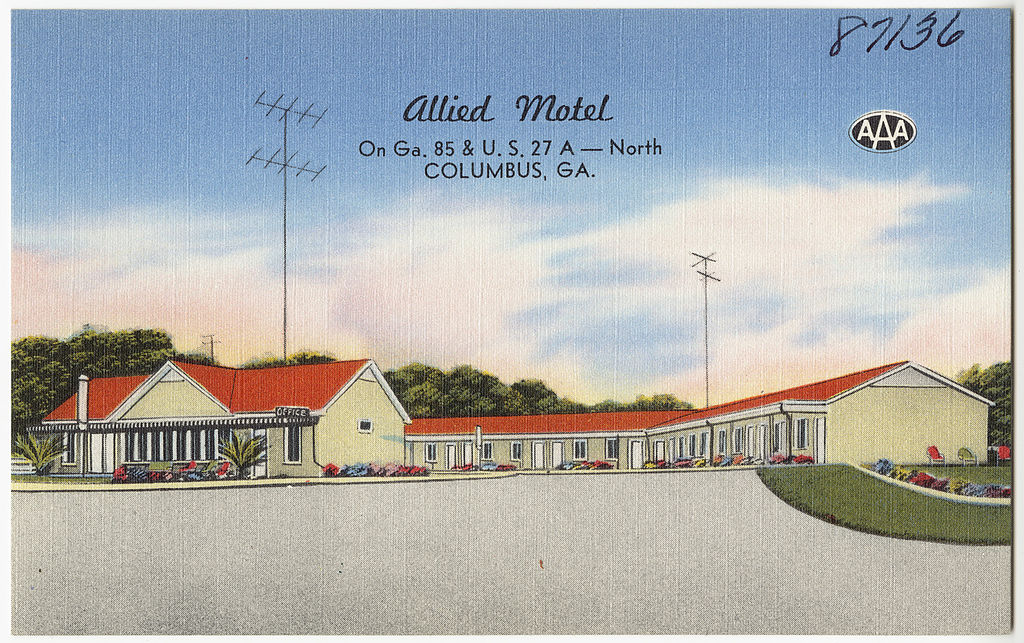
I’m in Columbus, Georgia tonight, resting up for a packed day tomorrow with the GALA (that’s Georgia/Louisiana) quilters. We did a meet-and-greet this evening; tomorrow it’s two lectures, a workshop, and a trunk show and book signing. My evening will be free and my hosts asked me if I wanted to go see the downtown area, take in a view of the Ocoee River, at least drive past the American Infantry Museum though it’ll be too late to go inside. Yes, I want to see these places. Yes, I want to get a feel for this place before I leave, before I know it. I’m a citizen of this country, after all. I ought to know where I live.
Columbus is Detroit is Palatine is Napa is New Haven is Greenwich is Pensacola is Boise is Brooklyn is Dyerstown is Eugene is Toledo is West Ridge is Princeton is Davenport is Fairfield is Bangor is you is me is you is me is me is me is you is you is me.
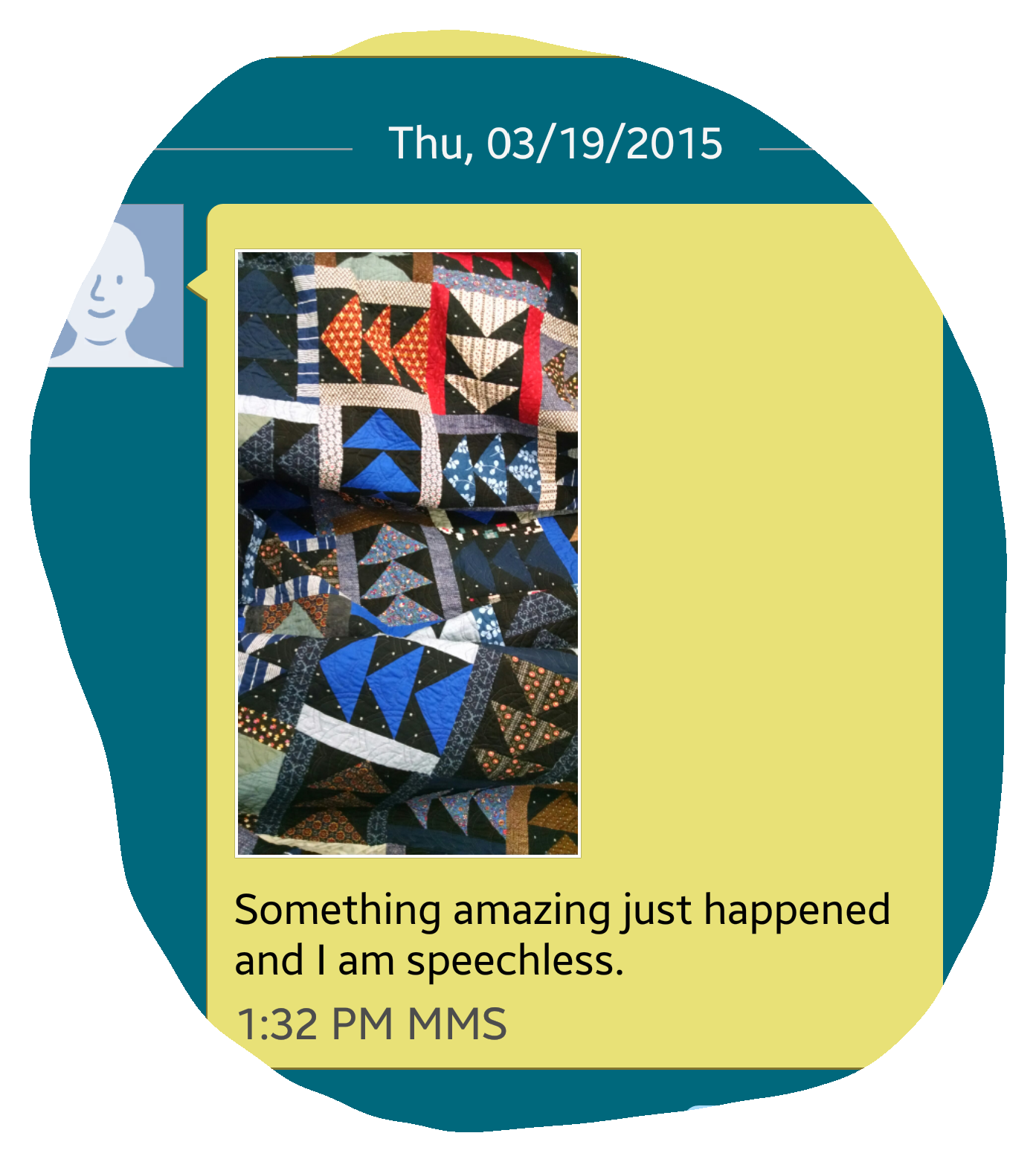
Do you have quilts in your house that are just sitting there? Are they folded, perhaps in the closet, perhaps on a shelf? Put another way: is it time for you to give some quilts away? Probably.
Generosity is in quilters’ DNA. We typically do give quilts away, which is fabulous if you’re a person who knows a quilter, because if you wanted to buy a beautifully made, king- or queen-sized quilt, it would cost you several thousand dollars; if a quilter loves you, you get it for free.
I give quilts away because there is nothing worse than looking at a stack of beautiful quilts languishing in my closet or in baskets around the house. What good are they doing there? The joy is in the making. Once the quilt is finished — unless it’s one I’m going to use for teaching or one that means so very, very much to me personally it’s like a limb — it’s time to give it away. Everyone but everyone needs a handmade quilt.
Today, my bestest friend Sarah got her quilt. It was a wedding gift way overdue. It’s the cover quilt for my book, Make + Love Quilts (available at fine bookstores everywhere!) It’s perfect for her, her husband Seth, and their kids, Little Seth and baby Katherine.
The quilt is out of my studio, out of my home, out of my life. I couldn’t be happier.
I love you, Greer!!!!