By now, my mom should know better than to leave a good nonfiction book on the kitchen counter when I’m home.
“What’s this?” I asked yesterday, picking up the fat yellow paperback.
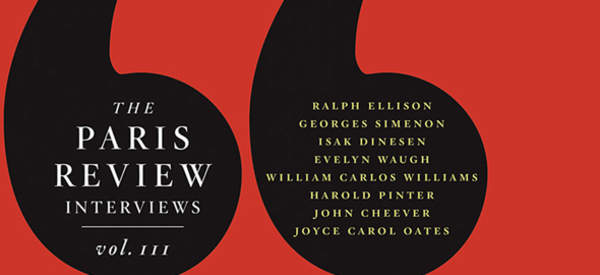
“Oh, I thought you’d like that,” Mom said. “I ordered it from Amazon. The Paris Review collected interviews they did with famous writers over the years. It’s really –”
The Wylie Coyote “vvvvvvvzzshoooom!” sound could have been heard, that’s how fast I zipped out of the kitchen with the book under my arm. Plates were spinning in the cupboards, the fruit jumped out of the fruit bowl in my wake.
I sank down into the couch for the next hour, poring over interviews done with Dorothy Parker, Truman Capote, Richard Price. It was as though I was in the room with the writers themselves, that’s how good the interviews were. It bordered on spooky. Look here at Dorothy Parker on working at Vogue:
“I wrote captions. “This little pink dress will win you a beau,” that sort of thing. Funny, they were plain women working at Vogue, not chic. They were decent, nice women — the nicest women I ever met — but they had no business on such a magazine… Now the editors are what they should be: all chic and worldly; most of the models are out of the mind of Bram Stoker, and as for the captions writers — my old job — they’re recommending mink covers at seventy-five dollars apiece for the wooden ends of golf clubs ‘”for the friend who has everything.’”Civilization is coming to an end, you understand.”
I hooted when I read that, and it was just one answer in one interview on one page! The book is a goldmine but it’s also dangerous — like an actual gold mine. This morning, still in my pajamas, I reached for the book and went directly to the Ernest Hemingway interview even before I went to get a cup of coffee. From there (now with coffee) I moved straight into T.S. Eliot, and then began Saul Bellow (with third cup of coffee.) Two pages into Bellow, I stopped because this was way too much genius before breakfast and I was beginning to freak out. Two reasons:
1. I’m a hack
2. Facebook
The first problem needs no explanation. The second problem has to do with a question posed to T.S. Eliot. His Paris Review interview took place in 1959, and the interviewer asked Eliot whether he thought the poet’s job was getting harder and harder because of mass communication. Since everyone was watching ABC, CBS, the BBC, etc., wasn’t a homogenization of language bound to happen? Wouldn’t everyone be speaking the exact same, “BBC English” before long? What good would nuance be? Where would poetry fit? Eliot was like, “Yeah, it won’t. We’re in deep [bleep].”
Another favorite author of mine is Nassim Nicholas Taleb; he wrote a passage on “Facebook English” in one of his books and he’s talking about the same problem the interviewer discussed with Eliot in 1959. Except that now we’re dealing with the Internet on top of all the television, so “Facebook English” is faster-spreading and more deeply homogenizing than TV ever was. We are doubling-down on homogenizing our already-homogenized culture. Running language through these sameness mills is like stripping paint and then stripping the stripped wall. This is alarming, comrades.
And I’m not talking about grammar. I don’t give a jot or a tittle if you say “done gone” or use “U” for “you.” That’s not a problem. In fact, variations and dialects, odd strains and rogue words are what we do want in language. The scary thing is when we all agree on a basic, one-size-fits-all tongue that becomes flat, dead, meaningless.
If it’s unclear, this is a book recommendation. I leave you with this from Hemingway, who never had to hire a social media consultant to help him with SEO and still ended his own life at the breakfast table. What would have happened if he had to keep up on Twitter?
Interviewer
As a creative writer what do you think is the function of your art? Why a representation of fact, rather than fact itself?Hemingway
Why be puzzled by that? From things that have happened and from things as they exist and from all things that you know and all those you cannot know, you make somethig through your invention that is not a representation but a whole new thing truer than anything true and alive, and you make it alive, and if you make it well enough, you give it immortality. That is why you write and for no other reason that you know of. But what about all the reasons that no one knows?


Leave a Reply