

This coming week has me heading over to Atlanta to teach and speak at the Original Sewing & Quilt Expo. This is one of my favorite gigs to do because I get to see Marlene. Marlene is the brains behind the Atlanta operation among other, similar operations and has been a friend and mentor to me for years. She was most publicly my friend when I went down in flames in Atlanta a number of years ago; without her help, I might still be casting about in the halls of a hospital in Georgia, filling out endless forms in triplicate and not getting the good kind of pain medicine.
Whenever I go to Atlanta, I am reminded of the first time I went to Atlanta. I was traveling with Bari; like Marlene, Bari is the sort of person you want around when the zombie apocalypse comes. It was awhile ago, but I remember Bari needed to drive to St. Louis to deliver something to her grandmother. That sounds like a cover for something, but I think it was legit. Bari grew up in the Atlanta area and her parents still lived there; for some reason, it made sense for her to drive to Atlanta and then go on to grandma’s house. Bari and I were living together that summer and she asked me if I wanted to go. I had no plans and I loved Bari. We got in her SUV and got on the road.
Bari’s family home was the finest house I had ever been in up to that point. The architecture, the interior, the grounds — these people had impeccable taste in every area in which impeccable taste matters (e.g., food, art, dogs, etc.) And they were all so nice! Within an hour of being welcomed inside, I got used to the fact that there was a grand staircase in the front of the house and a back staircase in the back of the house. I wanted to live in the kitchen and could have, perhaps with ten or eleven other people.
Bari showed me to my own guestroom where I had my own bathroom and my own balcony, I think. There were silk sheets on the bed and I had packed silk pajamas. When I got into bed that night, I really slid around.
All the comfort of that home was thrown into sharp relief the week after: I went to visit my boyfriend Dan in New York City and we heard a dog get shot. Dan lived in Bushwick, Brooklyn, a decade before Bushwick began to be remotely cool or safe. I didn’t like being there, but I really liked Dan. One night, we were going nuts listening to this dog bark and bark and bark and bark and bark and then we heard a gunshot and the dog didn’t bark anymore.
In life, as in patchwork, contrast is what makes things interesting.
I’ve been asked, “How do you come up with something to write every day?”
There are two parts to the answer. The first is that I want to be a decent writer and the only way to get decent at something is to practice. It’s true for a violinist. It’s true for a bridge player. I’ll never be a great writer, and I know that. Earnest Hemingway was a great writer. Virginia Woolf was a great writer. Both of those writers committed suicide, though, so maybe I don’t want to be a great writer.
“Now, now, Mary. Plenty of great writers did not commit suicide.” I’ll say yes, that’s true, and why are you speaking to me like a governess? The point is that even though I’ll never be great, I can be better than I was last year, hopefully. That’s the goal.
The second part of the answer is that I’m a naturally observant person and things that I see frequently make me intensely sad, excited, or confused. Frequently I see comedy, or at least what I perceive as comedic. I find those things worth examining more closely, even if they are otherwise insignificant things and they usually are. Writing stuff down is my preferred method of more closely examining things. I’m a terrible oil painter.
I suppose there’s a third reason: I like writing PaperGirl so much that if I miss a day, I’m grumpy. There was a spell this past holiday season when I was really lax and it was uncomfortable, like having a poke-y tag on my shirt. So sometimes I just plain make myself write about something because I don’t sleep as well if I don’t.
This morning was strange. I drew a blank. My aborted or curtailed travel plans were off the table. I didn’t want to write about my body. I couldn’t think of something funny that happened to me. I did see a shooting star the other night but I didn’t feel like being woo-woo. So I did something I’ve never done, which was to google, “non-fiction writing prompts.” It turned out to be a very good idea, because none of the prompts inspired me, but the act of looking up writing prompts was a writing prompt in itself. It also prompted me to create my own prompts. You have my permission to use them.
What is your personal credo?
Closely examine your feelings on olive loaf.
What stops you in your tracks?
How do you feel about adults who take tango lessons? Explain.
What the heck is wrong with you and what are you going to do about it?

Bad Things That Happened Today
Wanged the back of my leg so hard I whined about it for 30 minutes
The to-go coffee I got was lukewarm
Someone stole my cell phone
I can’t talk about that last thing. There was weeping. When anything goes wrong with my mobile phone, I am reminded how much I resent them for having to exist, to be on my person, and to function perfectly at all times. It’s just a cell phone. But still.
Phenomenal Things That Happened Today
Got a kiss
Wore new boots that did not hurt my feet
Saw that the third-ever episode of the Quilt Your Heart Out podcast was posted on the Quilt Your Heart Out website
The last thing zeroes out any woe I might’ve had about modern technology because modern technology is to be thanked for the whole podcast thing. If you don’t know by now, my mom and I have started a call-in advice show for quilters. You don’t have to be a quilter to enjoy it, but if you are a quilter, you will freak out.
Here’s hoping you find some things in your day that are so good (e.g., good falafel, good hair, good heavens, etc.) they cancel out any bad things (e.g., bad apple, bad dog, bad company, etc.) That podcast will make you smile, so there’s that.

Yesterday’s story about quitting a restaurant job in the name of making no money in the name of art reminded me of other tales, all from my early twenties. I did not sleep well. Thinking back on my early days in Chicago, I am filled with a 2:1 ratio of compassion and chagrin: I love the girl who moved to a major city alone, knowing no one, having only a vague idea of what she was going to do once she arrived; I wince when I think of what bar she thought was cool and which lampshade she chose to wear on her head while she hung out there. Youth is wasted on the young — and youth was wasted last night, too.
I moved to Chicago before smartphones. In black and white, here, right now, I am officially “dating myself,” which is something that until this moment, other people older than me did. Well, here we go: I’m dating myself, but I remember what it was like to move to a new city and not have a magical electronic map in my pocket that talked to me. I had a foldout thing I got for graduation, a wing, and a prayer. Just one wing? When has one wing ever worked?
I did not know my way around the city. At all. And I didn’t know anyone, either. I got off the Brown Line train at Wellington a couple days after I had gotten my apartment. The Wellington Brown Line station is on Wellington Street of course. But my apartment was twenty-six blocks west of that station. All I knew was that I lived on Wellington St., so I was like, “Oh. Okay. Well, I don’t know where I am but I live on Wellington, so I’ll just call this one good.” I got off the train. And I walked twenty-six blocks. I realized I was really far away from where I needed to be, but I was on Wellington and the numbers were going up, so I just kept going. I couldn’t spend money on a cab. I didn’t know the bus lines. If I had had a smartphone, that never would’ve happened. Because GPS is watching.
I’d like to say, “And I’m glad I didn’t have a smartphone! That was good for me, that horrible, hot, summer day in Chicago, walking miles and miles.” But it wasn’t good for me. It was bad. I was sad, lost, and alone. There’s no other way to say it. It took so long.
The image above conveys perfectly my disorientation that day. The word “Wellington” always reminds me of “Paddington,” as in Paddington Bear. After seeing WikiCommons’ offerings for the Wellington El stop, I searched for images of Paddington Bear. Nothing good there either, so I went for “Wellington boots.” This image of a Japanese theme park came up on that page. That is actual Japanese in the caption. I have no idea what it says.
My point is that thirty-six is is better than twenty-two; thirty-six with a Samsung Galaxy Note 5 is better still. I will try not to be twenty-two in tomorrow’s post.
When I was new in Chicago — this is fifteen years ago, now — a friend of mine helped me get a job as a hostess at a downtown restaurant. The restaurant was a citywide chain so popular, Saturday night at the host stand felt straight-up dangerous. Elbows were thrown. Twenty-dollar bills were passed to the maitre-d’ for special treatment (woe betide the tipper if the guy from out of town waiting three hours already spied the exchange.) Wine was sloshed. It was loud. And it was an hour commute on the train from my tiny apartment in the middle of nowhere.
I had learned to eat well in college. I worked as a waitress at a cafe there in Iowa City and got my culinary education — and dating the head chef for most of that time meant I got, you know, tutoring help and stuff. By the time I got to Chicago, I actually knew a little about wine. I could make a pan sauce all by myself. This small-town girl not only knew what sweetbreads were, she would order them if she found them on a menu. Aside from the occupational hazards, being a hostess just felt wrong. I was in a restaurant but not doing what I could do. I knew a restaurant job was what I would have for awhile, but the role and the restaurant had to change.
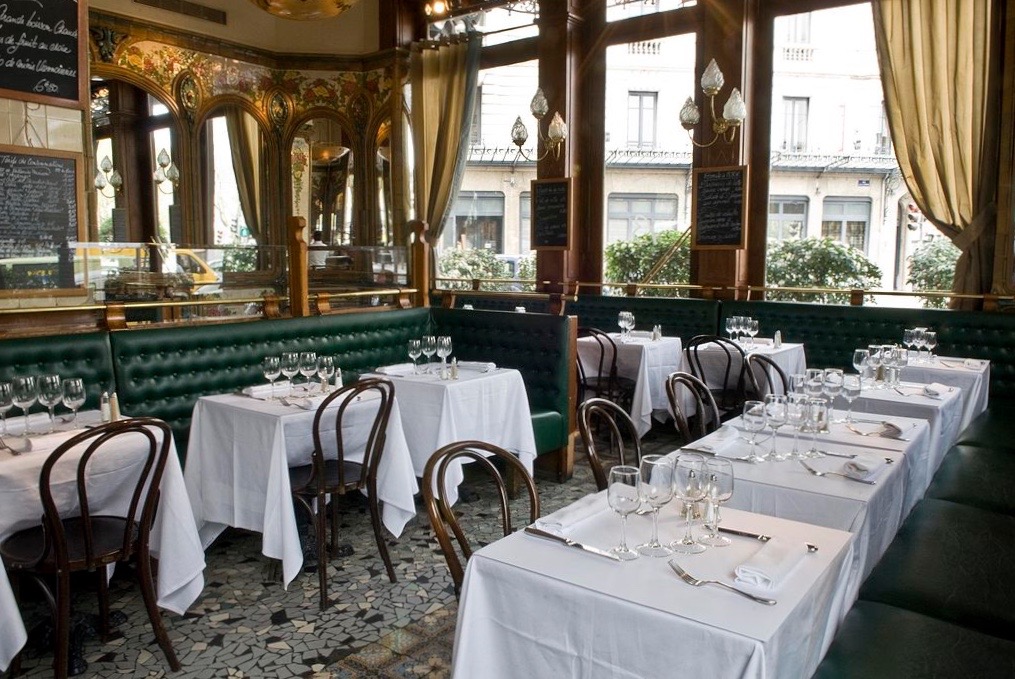
There was an ad in the Chicago Reader for a waiter at a two-star (Michelin stars, that is) restaurant on Taylor Street. Let’s call it The Fancy Napkin. This place was gorgeous: an upscale French bistro owned by a Moroccan man who looked like a swarthy James Bond. The cafe sat sixty, tops, outfitted in impeccable white linen; the waiters wore impeccable white bistro aprons. Each wine glass was spotless and the lights from the chandeliers glinted off them all. Steaming bowls of boulliabaisse. Crusty baguettes. And if you wanted to spend north of a grand on a bottle of wine, the restaurant would be happy to help you do that.
I applied. There were no female waiters, just three dudes, one of whom had been there over ten years. I had to take a wine test. I had to answer serious menu questions. I forget what the owner asked me, but it would’ve been things like, “What is canard? What is mille-feuille? Pair wine with the caviar plate for me.” I got an hour with the menu and then had a quiz. I did very well on everything and the owner offered me the job. But I had a problem.
The theater company I was a part of was producing our first show. I had a small part in the second act. There was zero money. And I had rehearsals at night. As a hostess at the chain restaurant, I could be in the play: I’d just work the lunch shifts. But not at The Fancy Napkin — there was only dinner six nights a week. I told James Bond I would be thrilled to take the job and then gently broached the little matter of needing Wednesdays and Thursdays off for awhile, then swapping those out for the Friday and Saturday nights I’d need for the play. But not for long! Just four weeks or so? Sir?
This did not go well. After expressing his extreme displeasure over taking so much time to vet me, he told me something I will never forget: “Marie, you can be a poor artist. Or you can make a lot of money at this restaurant. But you can’t do both. Decide now. Do you want to be poor and in a little play? Or do you want to live?” I was speechless. I needed money. But the play. Theater was the reason I came to Chicago. But money. But art. But rent. But love. Oh, no, no, no. I was twenty-two years old.
So you know what I did? I took a walk around the block. Someone had told me once that if you have to make a big decision, take a walk around the block and say to yourself firmly, “By the time I get back to where I started, I will have my decision.” It works. You speed up the decision-making process. You get closer to the end of your loop and you’re still in a quandary and then bam! The solution presents itself. The whole way around the block, walking slowly, I didn’t know what to do. But when I got to the door, I did.
I quit the job.