


If all goes according to plan, three medical students will be renting my home very soon. I met them last night and I like them a lot.
I like the idea of three big brains living here, mainlining coffee, charging their phones, putting their scrubs in a hamper. My home is a good place to be (good vibes, true story) and my fondest wish is that these folks will be better doctors later because they lived here. They’ll be able to say:
“Remember our second year, you guys? That amazing apartment we had? Yeah… That was cool. Got me through Musculoskeletal Systems II.”
Then one of them will say:
“Can you believe that chick renovated her bathroom and kitchen and then freaking moved?”
And somewhere, far, far away, I will weep.
When they came to see the place, one of the gang arrived before the others and we had some time to chat. This pleased me a great deal. I have never known anyone in medical school until now, unless you count the army of interns and residents I have interacted with over the course of my being sick, which I don’t. But I’ve always been so curious about what med school is like, why a person chooses it, and how it all happens, from undergrad to loans to residencies to actual jobs. There in my own living room, I suddenly had the chance to talk to a pre-doctor about all that. I tried not to interrogate.
“Did you always know you wanted to be a doctor?”
“Are you driven by a deep love of practicing medicine?”
“Do you enjoy it?”
“Is there a secret form you have to fill out to eventually get that doctor look and smell?”
“What’s the hardest part?”
The young man was thoughtful in all his replies. (I didn’t actually ask him about the doctor smell, but I so wanted to.) The last question got me a great story, too. Here’s basically what he told me; I may have gotten some of the technicalities funky, but it’s definitely the gist. NOTE: Squeamish readers proceed with caution.
“Honestly, it can be extremely tedious. I was on a brain-bleed case not long ago. We removed a piece of the skull — well, the residents and the surgeon did. As a student, you’re not doing any of this, you’re just watching. From about seven in the morning till almost one o’clock in the afternoon, we stood there and just watched as the resident used a teeny, tiny tool to deliver a zap that cauterized bleeding blood vessels.
He’d see blood, zap it, wipe. Wait. See blood, zap, wipe. Over and over again, but there was less blood coming over those hours, so we were just standing there and watching this process. I finally had to leave, and the other students were like, ‘But they’re about to screw the skull back on!’ and I was like, ‘I’m good,’ and I went and got lunch.”
He also told me that when a piece of the actual brain is taken out and needs to be saved for later, they store it in your abdomen. Your abdomen is like a damn locker for your brain. Oh, the humanity. Oh, my.
I secretly hope they have awesome doctor parties here.
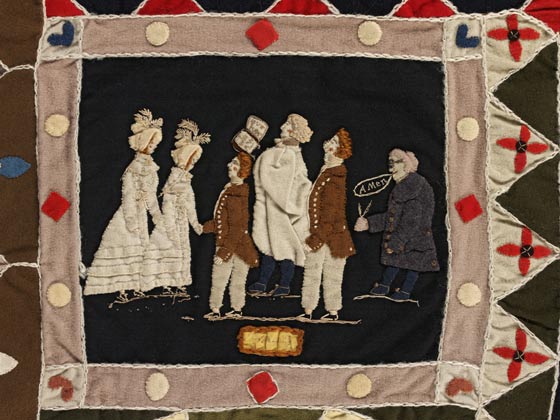
There was a tugging in my heart today and a longing I couldn’t place.
Oh, it was probably just nostalgia brought on by spring weather. The sweet, chilled spring air came in and I pulled out last year’s jacket. What was in the pocket but a pack of now-soggy gum and a book of matches from a fancy night out last spring. When these sorts of things happen, I need to read poetry.
After slogging through an afternoon’s worth of paper on my desk, I went to one of my favorite poetry anthologies to find something expansive. I was hoping I might find a poem on moving or relocation: I arrived in Chicago this morning at dawn and I have one week to wrap up all the ends here before trundling off to Manhattan for the summer. (Or longer. Probably longer.) When you crush up your arm, you need surgery. When you realize you’re about to say goodbye to the view from your bedroom, you need poetry.
I did not find a poem about relocation. What I did find was really good, though, especially if any part of what you do for a living involves sewing. And I know you’re out there.
“Song of the Shirt” is a poem by poet, writer, and humorist Thomas Hood, written in the 1820s in England. It’s about the suffering of the factory drudge, told from her perspective. It’s pretty bleak; it also pretty damn relevant. The refrain, “Work–work–work,” is as imbedded in our discourse as ever. I read it and cackled like a crazy person; she’s got that right. The poem was especially interesting/fitting because she speaks of spring.
I hope you enjoy the poem, as much as it can be enjoyed. In its admonishing way, it’s a little like being forced to take a dose of nasty medicine. But I said I needed help from a poem and that is exactly what I got.
Song of the Shirt
by Thomas Hood
With fingers weary and worn,
With eyelids heavy and red,
A woman sat in unwomanly rags,
Plying her needle and thread—
Stitch! stitch! stitch!
In poverty, hunger, and dirt,
And still with a voice of dolorous pitch
She sang the “Song of the Shirt.”“Work! work! work!
While the cock is crowing aloof!
And work—work—work,
Till the stars shine through the roof!
It’s O! to be a slave
Along with the barbarous Turk,
Where woman has never a soul to save,
If this is Christian work!“Work—work—work,
Till the brain begins to swim;
Work—work—work,
Till the eyes are heavy and dim!
Seam, and gusset, and band,
Band, and gusset, and seam,
Till over the buttons I fall asleep,
And sew them on in a dream!“O, men, with sisters dear!
O, men, with mothers and wives!
It is not linen you’re wearing out,
But human creatures’ lives!
Stitch—stitch—stitch,
In poverty, hunger and dirt,
Sewing at once, with a double thread,
A Shroud as well as a Shirt.“But why do I talk of death?
That phantom of grisly bone,
I hardly fear his terrible shape,
It seems so like my own—
It seems so like my own,
Because of the fasts I keep;
Oh, God! that bread should be so dear.
And flesh and blood so cheap!“Work—work—work!
My labour never flags;
And what are its wages? A bed of straw,
A crust of bread—and rags.
That shattered roof—this naked floor—
A table—a broken chair—
And a wall so blank, my shadow I thank
For sometimes falling there!“Work—work—work!
From weary chime to chime,
Work—work—work,
As prisoners work for crime!
Band, and gusset, and seam,
Seam, and gusset, and band,
Till the heart is sick, and the brain benumbed,
As well as the weary hand.“Work—work—work,
In the dull December light,
And work—work—work,
When the weather is warm and bright—
While underneath the eaves
The brooding swallows cling
As if to show me their sunny backs
And twit me with the spring.“O! but to breathe the breath
Of the cowslip and primrose sweet—
With the sky above my head,
And the grass beneath my feet;
For only one short hour
To feel as I used to feel,
Before I knew the woes of want
And the walk that costs a meal!“O! but for one short hour!
A respite however brief!
No blessed leisure for Love or hope,
But only time for grief!
A little weeping would ease my heart,
But in their briny bed
My tears must stop, for every drop
Hinders needle and thread!”With fingers weary and worn,
With eyelids heavy and red,
A woman sat in unwomanly rags,
Plying her needle and thread—
Stitch! stitch! stitch!
In poverty, hunger, and dirt,
And still with a voice of dolorous pitch,—
Would that its tone could reach the Rich!—
She sang this “Song of the Shirt!”

All hands on deck!
Yuri either has terrible allergies, a cold, a sinus infection, or he’s been possessed by a jinn specializing in cruel bouts of sneezing and mucus production. His stuffy nose is the kind that alternates one nostril and the other. It’s a “half-stuff.”
We tried 24-hour Claritin; it made Yuri feel worse. He tried Sudafed; same. He got plenty of rest over the weekend, since I was working the whole time, but he’s still sick or allergy-ing terribly, whichever it is. We did a dollop of VapoRub in a big bowl of boiling water and he steamed his head over that, under a big towel, just like my dad used to do. He neti-potted. He nose-sprayed. He got some of the little bands that stick to the bridge of the nose and open the passages while he sleeps and those help a little, but not a lot.
Yes, there’s always the doctor. It’s the next step.
Until then, educated, intuitive, Dr. Quinn-was-my-homegirl reader, what home remedies might you have for clearing a stuffy nose — or for at all relieving the symptoms I’ve outlined.
Surely none of your suggestions will involve honey suppositories or bathing in tomato juice or anything weird like that.**
**Fine: the weirder the better — but we do want something to work. Go!

For the past hour I have been working on the post I wanted to post this morning. It’s turning into quite a beast of an essay and it’s simply not ready for prime-time. It’s about Hollywood and how I can’t take it anymore.
Since I can’t post something half-baked but I hate missing a day — and because I’m bone-weary tired and need to introduce my head to a pillow for once in my life for heaven’s sake — I’ve decided to share a picture of Scrabble, my mother’s miniature Golden Doodle.
Scrabble is a dog that looks like a lamb, behaves like four-year-old child (curious, adorable, infuriating), and is named after a board game. She can fetch a quilt, shake hands, and has lots of work to do in the evenings: she has to run around the yard and bark for 20 minutes.
“Scrabble’s doing her barking work,” my mother will say, loading the dishwasher.
Scrabble loves me and I love Scrabble. This photo was taken at about six in the morning last month when I was home in Iowa filming TV. She sleeps downstairs, but when she wakes up in the morning, she’ll bolt all the way upstairs to my childhood bedroom and dive-bomb my head in order to cuddle me. She is not allowed to lick my face; she licks my face anyway.
Scrabble, if you were able to send emails for me or finish my blog post — or fact-check it at the very least, Scrabble! — you’d be even more precious to me than you already are. But I suppose your being a dog confers special qualities that cancel out your human shortcomings. So it’s a wash.
Goodnight, Miss Muddy Paws, wherever you are in the Iowa house tonight.
BONUS: I never do it, but you’ll see why this is worth an outside link. Watch Scrabble fetch her quilt for my Mom.
My paternal grandmother Venita wore denim skirts, drank Heineken, and had a black cat name Pru.
But this is where we see the ecstasy and the agony of words because while everything I just wrote about my paternal grandmother is true, it paints a wildly inaccurate picture of the woman. Venita wore long denim skirts; Ralph Lauren, usually, paired with turtlenecks and loafers. She drank Heineken once a year at the most and it was this big deal when she did. And her cat was indeed black and Venita did call her “Pru,” but that was short for “Prudence,” and “prudence” means “cautiousness” which is exactly what Venita was going for. “Cautious” is the perfect word to describe my late grandmother; she used to tie a damned bonnet on my head whenever we went outside so I wouldn’t get an earache. I got earaches anyway and I couldn’t hear anything.
Ach. Now I’m sad about the bonnet. She meant well.
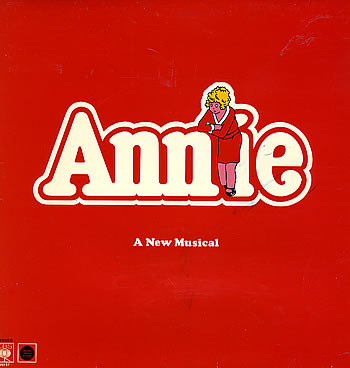
I owe Venita big, too, because when I was six I visited her and Grampa Lloyd in Houston and Gramma bought me a present: the 1977 original Broadway recording of Annie. As in “Little Orphan.”
The movie version came out in ’82 and I had seen it somehow; we didn’t have a VCR, so it must’ve played on network TV. However I knew the story, I knew it all right, and like any little girl who sees Annie, I was obsessed. The story was about me. These little girls were my homies. It wasn’t about being an orphan or having red hair; it was about being a small female with feisty friends full of song; it was about longing for happiness and attractive, capable parents and an indoor swimming pool.
When Gramma V. gave me the record, I probably didn’t know what I was looking at, exactly, since the Broadway art and the movie art look so different. But when Gramma put the needle on the record and that first overture played, a living room star was born. I learnt every groove in that wax, baby, backwards and forwards, from Miss Hannigan to Punjab and back and I sang — oooh! how I sang! — every single song at the top of my lungs. Annie’s a great musical, but if you’re six and female, it’s a religion.
“TOOOOOOOOOOOO-MAAAAAAAA-ROW! TOOO-MAA-ROW! I LOVE YAAA, TOOOO-MAAA-ROW! YER’ O-NLY A DAAAAAAAAAAAAAAAAY AAAAAAAAAAAAHHHHHHH”
:: pause to gasp for air ::
“WAAAAAAAAAAAAAAAAAAAAYYYYYYYYYYYYY!!!!!!!!!!!!”
Oh, my poor grandfather. Oh, that man must’ve wanted to kill himself. Because I could not stop at five repeats of my Annie record, nor did I stop for six. I could not stop for death, so Grampa kindly stopped the record for me after several hours each day. If I have any singing ability (and I have a teensy-tiny-weensy ability to belt, decent pitch, and nothing more) it’s because of Annie. If I am theatrical at times, it’s because of Annie. And I realized in searching for the image of the record up there, that my favorite color, a red in the carmine-vermillion-cherry family, is clearly Annie red.
All this came up because the other morning, lounging in bed, I suddenly burst into the key change section of “Sandy” from the musical. Yuri was as confused as I was, then I started weeping from nostalgia, and then I had to look up the lyrics, which I had gotten 90% right after all these years.
We are the songs we sang as kids, I think.