
There once was a woman named Fons,
Who longed to stroll green, lushy lawns
And seek brain diversity
At some university
(She was desperate for book liaisons!!)
“To grad school!” she said with a grin,
(For she applied and quickly got in
To a fancy-pants school*
Where brainiacs rule)
“I can’t wait!” cried Fons, “Let’s begin!”
A team of the wildest horses
Couldn’t have dragged her from taking those courses;
Her desire was burning
To slurp up the learning,
…But there were brewing unfortunate forces.
Work travel had always excited
The Fons; she was most delighted
To travel in planes
And meet Dicks and Janes
And see all the things that she sighted,
But suitcases don’t mix with classes,
And soon, our hero in glasses
Was forced to admit,
(Though it gave her a fit!)
Work demanded she leave the school’s grasses.
“I’ll be back and studying soon!”
She said, and whistled a tune;
There was no use in crying —
You know I ain’t lying:
E’vry moment spent learning’s a boon.
*University of Chicago, boo-yah
I met my friend Mark for lunch today at the Walnut Room. We sat near the windows and looked out at the gorgeous Chicago spring day.
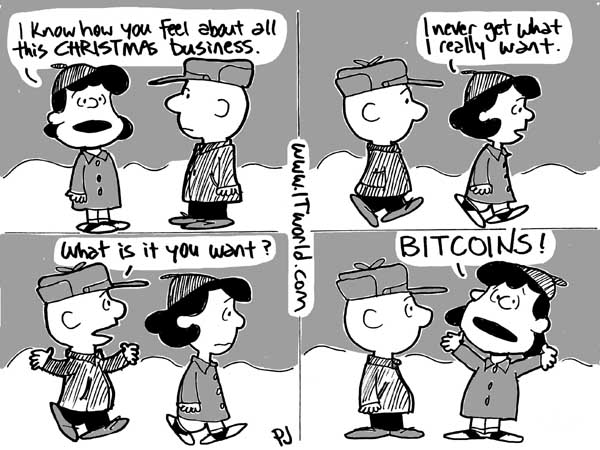
“I bought flowers for my mom online for Mother’s Day,” said Mark. “At the checkout, there was an option to pay with bitcoin.” Mark is extremely skeptical about pretty much everything, so he was grumpy: it’s hard to be wary of Bitcoin when it helps you buy flowers for Mom.
“That’s great!” I said, clapping. “I bought a mattress on Overstock.com with bitcoin. Did you read PaperGirl yesterday? It was all about bit –”
“Yeah, yeah, I read it,” Mark said. “That’s why I brought it up. I have questions. How do you buy them?”
I welcomed the interrogation. It was with some trepidation I dove into all this yesterday; talking to Mark might help me iron out the second half of my bitcoin treatise.
“You can go to Coinbase.com, set up an account, and buy bitcoin,” I said, “Or you can buy bitcoin in person, from a trader. I went on LocalBitcoin.com and found a trader with a great customer rating and met him and bought bitcoin from him. It was easy. It was fun.” Mark knows that that trader was Yuri. So romantic, right?? I know.
“And you use real money to buy them,” Mark said, eyeing me. The waiter came and we both ordered the tortilla soup.
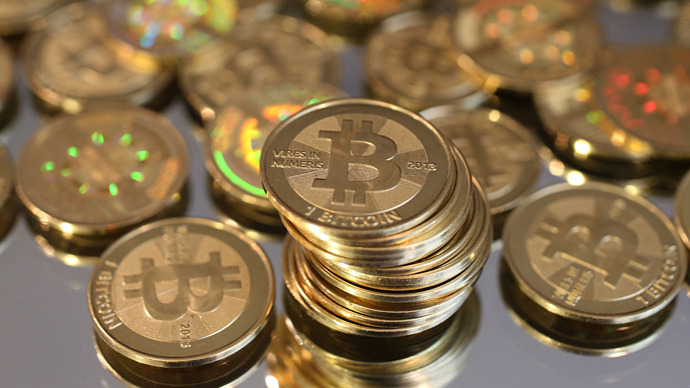
“Yes,” I said. “And they’re not actual coins, you realize. Each bitcoin is a line of code. And you put them –”
“Where do you put them?”
“In a bitcoin wallet, poodle. Just like you put cash or cards in a physical wallet, you put bitcoin in a digital wallet. Each bitcoin has its own serial number. Those numbers live in your phone or your computer. Remember, dollars have serial numbers too — and your credit card is a string of numbers — a lot of how bitcoin works we already use everyday.”
Mark shook his head. “What keeps someone from making up fake numbers? Making a fake bitcoin would be way easier than making a fake dollar bill, right? No paper. And is there a finite number of these things? Who invented it, anyway? And who’s profiting?!” Mark slurped his soup and then — with his mouth extremely full — he managed to say, “You’re never gonna be able to explain all this.”
I told him I’d try. And I’d keep it short, too.
In 2008, a programmer — possibly a group of programmers — known as Satoshi Nakamoto, wrote a brilliant piece of code and put it out on the Internet for free. Even the most dour of bitcoin critics agree: Nakamoto’s digital currency model was (is) genius. This is because his bitcoin model, among its other elegant features, got rid of two huge problems with buying goods and services online: 1) no longer did every single online transaction have to go through a bank or credit card company, with all their fees, security breaches, and data gathering; and b) he solved the problem of double-spending.
The first problem is easy to get your mind around, even if you don’t agree it’s a problem. Now, to that second thing. If you don’t have a bank or credit card company to vouch for you, to say, “Yeah, you really bought that llama — it shows it right here on your statement,” how can you prove you did? Equally bad — just as Mark worried — if someone, like a bank, isn’t monitoring the system, who’s to stop some guy from making all kinds of fake bitcoin and buying zillions of dollars worth of stuff (e.g., llamas) with fake money?
Nakamoto designed bitcoin so that the community of bitcoin users verify the transactions. Instead of a bank making one central ledger of what’s circulating, the bitcoin users do it, verifying all of the transactions — yep, every one of them — at the same time. There are a finite number of bitcoins in existence (21 million) and they all have a unique serial number or code. If someone tries to use a fake bitcoin, the transaction is caught as it tries to get through the system and it’s rejected. So there is regulation: it’s just in the hands of the people using the currency, not A Big Bank, not MasterCard or Visa. (We used to get along without those things, you know.) How all the verifications happen is rather complicated and computer-y and I am willing and able (more or less) to explain it. My fear is that I have asked much of you, gentle reader, and you have been most faithful; perhaps it’s wise to discuss that last bit (!) of the bitcoin system another day.
Two last things, and then let’s finish with the love story:
First, Bitcoin has a PR problem because in the beginning, the anonymity of the currency appealed to people buying nefarious things online. I hardly need to point out that as I type, lots of people are buying nefarious things, online and otherwise, with U.S. dollars, too. But this early sketchiness (and a trading company, Mt. Gox, that was doing bad business) dealt a harsh blow to bitcoin and it’s gonna be recovering from that for awhile. A few shady apples hurt the bunch, but as Bitcoin grows, matures, goes through a modicum of regulation, and problem-solves, these early specks will flick out. (Also: the “crypto” in “cryptocurrency” refers to the encrypted codes within the system, but people see “crypto” and register “cryptic” as in “confusing.” It’s not a perfect word, “cryptocurrency.”)
Lastly: Bitcoin is new. Really new. Anyone reading this is way ahead of most of the general public — and good for you! Curiosity and inquiry = great! More and more merchants are accepting the cryptocurrency for payment (e.g., Amazon, Gyft, Overstock, etc.) but until you can pay your energy bill online with it, bitcoin has a ways to go. It takes a village, but remember: the Internet itself was new not so long ago, and people were skeptical and cynical about it, too. Look where we are now.
One of the reasons I care so much for Yuri is because he wants to build the village. He believes in the ability of bitcoin to make the world a better place, so he works tirelessly for his company, a bitcoin trading firm in NYC. He is a miner. He goes out of his way to patronize businesses that accept bitcoin. He gets involved in the growing, global community and recently gave a lecture at his alma mater about his work. A person with a passion is a beautiful thing to behold. And to, you know, hold.
“I still don’t know,” Mark said, pushing his empty soup bowl away. “But I think it’s cool you tackled the topic. Good job.”
I thanked him, and paid the check. With my credit card.
My man is in bitcoin.
(This post — in two parts — is actually a love letter, but first we need to go over bitcoin.)
I’m pretty sure I know what you’ve heard about bitcoin, if you’ve heard of it at all: it’s sketchy, it’s complicated, it’s like money but it’s not actual money. Skepticism is a virtue, most attractive reader, and you’re right to have questions about any Next Big Thing, but if you’re working with incomplete or incorrect data, skepticism can quickly turn into cynicism, and that’s no fun for anyone, especially you, five years from now, when you smack yourself in the head for waiting on the whole bitcoin thing. I am not a bitcoin expert, but I have been using and trading the currency for well over a year now, and I think I can break it down for you a little bit so that it’s not so confusing or scary. Because bitcoin isn’t either one.
* * *
Do you remember a time when we didn’t use credit/debit cards to pay for absolutely everything we buy? I do. I was in high school.
My favorite thing ever was to drive to this record shop in Des Moines to buy bootlegged Tori Amos concert recordings. They were thirty bucks a pop, which was way too much, but I didn’t care. I’d find the CD I wanted most and, if I had thirty bucks cash in my wallet from waiting tables at Pizza Hut, I bought my record. There were no transaction fees. My purchase was not recorded in the Big Data cloud. The guy working the counter couldn’t steal my credit card number when I left. And, very important: if I didn’t have enough money to buy my CD I didn’t get to buy it. In other words, the whole thing was a cash transaction, great for all kinds of reasons.
I’ll say this a few more times, so you’ll have time to let it sink in: Bitcoin is cash on the Internet.
Right now, to buy anything online, from a cool scarf on eBay to a magazine subscription to a small llama, airplane hangar, franchise, etc., you have to use a credit card. (PayPal is linked to your credit card and/or your bank account, so same thing.) Whatever, whenever, and wherever online you buy, because you have to use a card, you’re traceable, data-mineable, and vulnerable to identity theft. You’re paying fees, the merchant is paying fees, and you are more than welcome to go into hideous debt if you wish, since credit cards let you buy all kinds of things (including small llamas) without actually having the money to pay for any of it.
This is not good.
I don’t particularly like ceding so much financial power/intel to MasterCard, Visa, etc. Think about it: do you want MasterCard all up in your business? Is it okay they’re tracking your llamas? Nevermind the agony of stolen card numbers. It happens so often, now. It happened to me this past holiday season, with the huge Target security leak. I had multiple charges in Lithuania on my credit card statement — and I was not in Lithuania at Christmastime. Not cool, Status Quo, and it wouldn’t have happened if I had simply paid for my milk and my chewing gum with cash.
Remember: Bitcoin is cash on the Internet.
My darling Yuri is a visionary. He believes, as many people believe, that Bitcoin is the future of money, not just in this country but in the whole world. Because something must change.
The government bailouts of the banks, the financial industry scandals, the weird economy, the projected $9.1 trillion dollars Mister Obama is setting us up to owe in the next few years — this stuff concerns Yuri and it concerns me, too. The U.S. dollar isn’t pinned to gold anymore, you realize: ours is a fiat currency, a monetary system that derives its value from government regulation or law. Pardon, but the words “value” and “government regulation” give me the willies when they’re in the same sentence. I’m a full-blooded American, what can I say? I’m into apple pie, eagles, and the government leaving me alone. All signs point to disaster with money being run like its being run these days, and as it gets worse, bitcoin will rise.
Bitcoin is a global, Internet-based currency available to everyone. Bitcoin with a capital “B” refers to the overall payment system; bitcoin with a lowercase “b” refers to the monetary unit. Bitcoin is considered “cryptocurrency” because it uses computer encryption to secure transactions. That’s all the technical stuff I’m going to throw at you right now. Tomorrow, we’ll get into how it actually works, okay? Okay. You’re doing great! It’s all really new, I understand, but you’re very smart and you’ll be helping to explain bitcoin to your friends at bridge club before you know it.
And I haven’t forgotten the love story, don’t worry. You see, I met Yuri because I bought bitcoin from him.
*Dangerously close to discussing politics on PaperGirl. Exeunt! Exeunt!

Music plays a strange role in my life. When I was in high school and college, I was typical, obsessed with the musicians that I was obsessed with: Tori Amos, Joni Mitchell, Bjork, PJ Harvey, Ani DiFranco, Fiona Apple. I listened to their records over and over and over, through headphones, through “boom box” radios, via cassette mixtape in my Honda CR-X. If you had tried to take my music away from me, I would’ve snarled like a rabid cat. And I woulda’ bit, too.
I’m not so slavish to my artists, now. When I walk up Michigan Avenue the whole way, I usually listen to music. But I have longed moved from emo singer-songwriters to brash female emcee’s: Nicki Minaj, Angel Haze, Azalea Banks, MIssy, L’il Kim, and most recently, Iggy Azalea. These women fit me better right now: I don’t want obscure metaphor; I want life, served up cold.
Something’s trending though, in my head: lately, I’ve been choosing to take the earbuds out and just listen to the city when I”m walking or taking public transit. With no Prince blaring in my ears, I hear birds, traffic, conversations. I feel more in touch with the place. Headphone music is great, but it takes you away from where you are, and lately, I like being where I am. It’s confusing, it’s unknown, but it sure is exciting. And so I need to make sure I can hear when opportunity or goodness knocks.
I leave you with the lyrics of Prince’s immortal, “Let’s Go Crazy.” It’s a great song with a brilliant message. Besides, you can dance to it. Do a close read and be in a better mood, instantly.
LET’S GO CRAZY
PrinceDearly beloved, we have gathered here today
To get through this thing called “life.”
Electric word, “life;” it means forever — and that’s a mighty long time
But I’m here to tell you: there’s something else.
The afterworld. A world of never ending happiness.
You can always see the sun, day or night.So, when you call up that shrink in Beverly Hills —
You know the one; “Dr. Everything’ll Be Alright”?
Instead of asking him how much of your time is left,
Ask him how much of your mind, baby
‘Cause in this life, things are much harder than in the afterworld
This life you’re on your ownAnd if the elevator tries to bring you down
Go crazy punch a higher floorIf you don’t like the world you’re living in
Take a look around you; at least you got friends
Call my ‘ol lady up, for a friendly word
She picked up the phone, dropped it on the floor
“Ahh, ahh” is all I heardAre we gonna let the elevator
Bring us down, oh, no let’s go
Let’s go crazy, let’s get nuts
Look for the purple banana
‘Til they put us in the truck, let’s goAll excited but we don’t know why
Maybe it’s ’cause we’re all gonna die
And when we do, what’s it all for
Better live now before the grim reaper
Come knocking on your doorAre we gonna let the elevator
Bring us down, oh, no let’s go
Let’s go crazy, let’s get nuts
Look for the purple banana
‘Til they put us in the truck, let’s wait it your turn.Come on baby let’s get nuts
Yeah, crazyLet’s go crazy…”
Read more: Prince – Lets Go Crazy Lyrics | MetroLyrics
I heard an incredible story in Florida.
On certain gigs, I work alongside a sewing machine specialist, or “educator.” My portion of the day’s program will include patchwork instruction, design theory, demos, show n’ tell of quilts, discussion about the industry and the shows I host, etc.; the educator shows the good people all the backflips and the loop-the-loops the machines are capable of performing. I sew a lot, but in no way do I know all the marvelous things Babylock sewing machines can do — that’s why the specialist is there.
I love the women who do this stuff. These are lifelong sewists, women who were sewing doll clothes at five, quilts at ten, and made their own clothes — and often their children’s clothes — until it became economically irrational to do so.** Educators are technical masters, true engineers. They could probably figure out how to sew a small house if you asked them to.
Joyce was my educator down in Florida and I liked her a lot. A Wisconsinite, an extremely spry great-grandmother, and an experienced teacher with a Midwest work ethic, Joyce and I easily formed a united front against the unknowns that face you on any gig. We were a good pair and we did a good job.
Driving in Joyce’s white rental car on our second morning together, I asked her when she had started teaching.
“Oh, that’s a good story,” she said. We were passing through cotton fields, deep in the Panhandle.
“When I was in high school,” Joyce said, “I took every home ec or sewing class they offered; the regular classes, the advanced stuff — everything. They made me take woodworking, you know, which was silly. I loved to sew. I like to say I was born with a needle and thread in my hand. By the time I was a senior, I was pretty good.
“The woman who taught home ec was a terrible alcoholic. She would come in in the morning and you could smell the booze on her a mile off.”
“How awful,” I said.
“Yep,” said Joyce, “It was pretty sad. Well, one day, first period, she was in such bad shape she asked me if I would take over for her. I knew the stuff we were doing, so I said sure and I taught the class. After that, she made me a deal.
“She said, ‘Look, kid: you teach my first and second period class, I’ll give you an A the rest of the year, no questions asked.’
“I said that sounded good to me. So that’s just what I did. Miss Knickerbocker^^ would come into school and go straight to the cloak room. We had cloak rooms back then, and she’d go in there where it was nice and dark and she’d sleep it off for a few hours while I taught home ec.”
My eyes were wide as dinner plates.
Joyce laughed. “Isn’t that funny? I taught high school home ec for a year while I was in high school.”
I have thought about this story every single day since she told it to me. I picture that teacher, Miss Knickerbocker, forty-something, once attractive but now really showing wear and tear, stumbling into the school, sucking on peppermints to hide the smell of booze on her breath. I see her in a matching skirt and jacket, maybe a brooch. Oh, Miss Knickerbocker! You are such an uncomfortably fascinating character. I wonder what happened to you.
Thanks to Joyce for the story.
**For several decades, now, it’s been cheaper to buy clothes than it costs to make them yourself, which is a crazy, crazy paradigm shift in our nation’s history so far.
^^I changed this lady’s name.